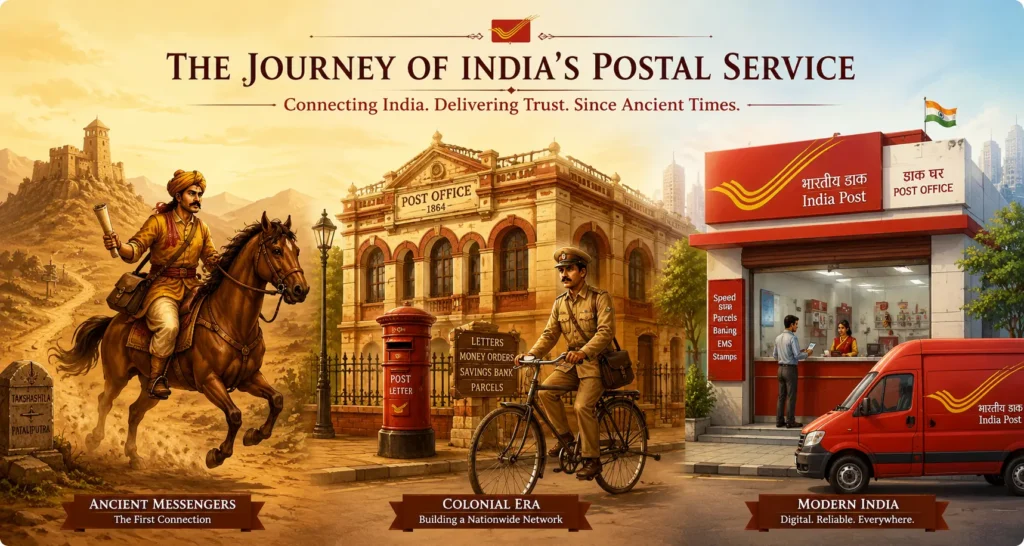
History of India Post– Do you remember the sound of the postman’s bicycle bell, or the excitement of getting a handwritten letter from a relative living far away? For most of us, those memories feel like they belong to a different world. Today we send a WhatsApp message and get a reply in seconds. But before all that, there was one system quietly connecting every village, town, and city in India — the postal service, known today as India Post. A very interesting story is about History of India Post, that is unbelieve. A very long journey from pre freedom era to Modern age.
What’s amazing is that this isn’t just a 170-year-old British invention. The story of sending messages across India goes back thousands of years, long before stamps, envelopes, or pin codes even existed. Let’s walk through this fascinating journey about History of India Post.
History of India Post: The Ancient Beginnings
History of India Post begin from British rule. Long before there was anything like a “post office,” Indian rulers needed a way to send orders and news across their kingdoms. During the Mauryan Empire, around 300 BCE, Emperor Chandragupta Maurya divided his empire into provinces, and keeping in touch with far-off regions was a real challenge. To solve this, messengers travelled on foot and horseback carrying royal instructions.
One of the most interesting parts of this early system was the use of trained pigeons. Small messages were tied to the legs of pigeons, which were then released to fly straight to their destination. This pigeon-post tradition continued even during the reign of Emperor Ashoka, and — believe it or not — a version of pigeon mail survived in India all the way until 2008, when the last official pigeon post service finally closed down in Cuttack, Odisha.
History of India Post: The Medieval Era- Faster Roads, Faster Riders
As dynasties changed, so did the postal system. During the Delhi Sultanate, Qutb-ud-din Aybak introduced an early messenger system in the 13th century. Later, Alauddin Khilji expanded this into a proper network of horse riders and foot runners to keep communication moving quickly across the kingdom.
Then came Sher Shah Suri in the 1540s, who is often credited with one of the biggest upgrades to India’s communication network. He replaced foot runners with horse riders and set up “dak chowkis” — essentially mail relay stations — along the route that we now know as the Grand Trunk Road. This road still runs today, connecting cities from Bangladesh through India and into Afghanistan.
The Mughals carried this system forward too. Under Babur’s rule, the Agra-Kabul route became an important communication link, with fresh horses stationed roughly every 36 miles so messages could travel quickly across long distances.
History of India Post: The British Era
The postal system as we recognise it today really started taking shape under British rule. The East India Company opened its first post offices in Bombay in 1688, followed by Calcutta and Madras a few decades later. At this stage, though, the postal system mostly served the Company’s own trade and administrative needs.
That changed in March 1774, when Warren Hastings, then Governor-General of India, opened up the postal service to the general public for the first time.
History of India post: Key Milestones
If you’d like the full picture at a glance, here’s a year-wise timeline covering nearly 300 years of India Post’s journey, from the first post office in Kolkata to the most recent regulatory reforms:
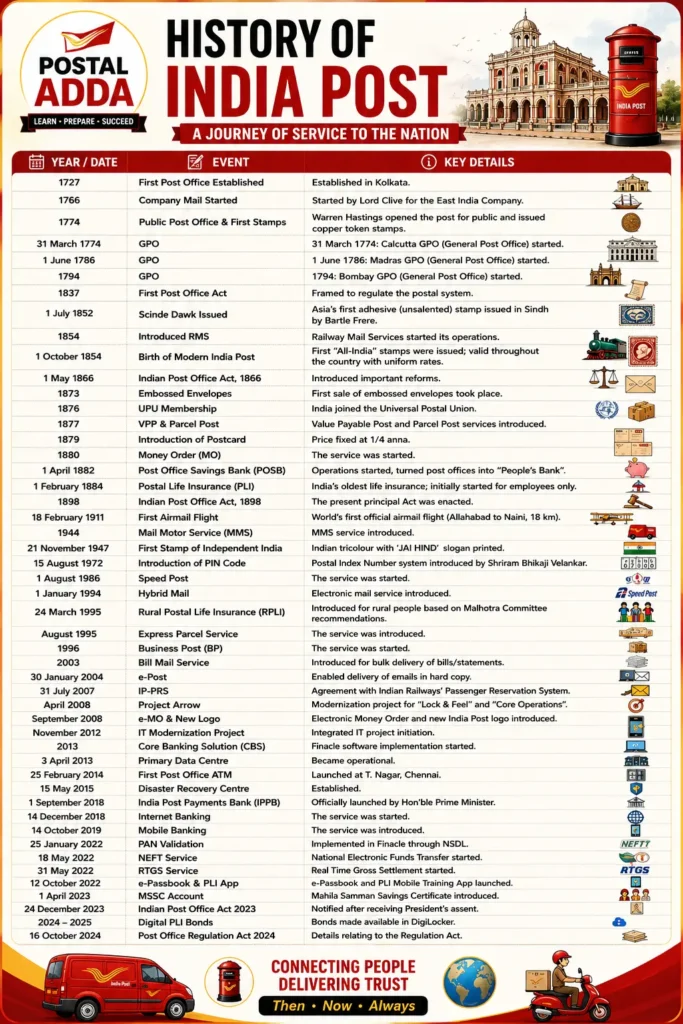
| Year / Date | Event | Key Details |
|---|---|---|
| 1727 | First Post Office Established | Established in Kolkata. |
| 1766 | Company Mail Started | Started by Lord Clive for the East India Company. |
| 1774 | Public Post Office & First Stamps | Warren Hastings opened the post office for the public and issued copper token stamps. |
| 31 March 1774 | GPO, Calcutta | Calcutta GPO (General Post Office) started. |
| 1 June 1786 | GPO, Madras | Madras GPO (General Post Office) started. |
| 1794 | GPO, Bombay | Bombay GPO (General Post Office) started. |
| 1837 | First Post Office Act | Framed to regulate the postal system. |
| 1 July 1852 | Scinde Dawk Issued | Asia’s first adhesive (unsealed) stamp issued in Sindh by Bartle Frere. |
| 1854 | RMS Introduced | Railway Mail Service started its operations. |
| 1 October 1854 | Birth of Modern India Post | First “All-India” stamps issued; valid throughout the country with uniform rates. |
| 1 May 1866 | Indian Post Office Act, 1866 | Introduced important reforms. |
| 1873 | Embossed Envelopes | First sale of embossed envelopes took place. |
| 1876 | UPU Membership | India joined the Universal Postal Union. |
| 1877 | VPP & Parcel Post | Value Payable Post and Parcel Post services introduced. |
| 1879 | Introduction of Postcard | Price fixed at 1/4 anna. |
| 1880 | Money Order (MO) | The service was started. |
| 1 April 1882 | Post Office Savings Bank (POSB) | Operations started, turning post offices into a “People’s Bank.” |
| 1 February 1884 | Postal Life Insurance (PLI) | India’s oldest life insurance scheme; initially started for employees only. |
| 1898 | Indian Post Office Act, 1898 | The principal Act that governed postal operations for over a century. |
| 18 February 1911 | First Airmail Flight | World’s first official airmail flight (Allahabad to Naini, 18 km). |
| 1944 | Mail Motor Service (MMS) | MMS service introduced. |
| 21 November 1947 | First Stamp of Independent India | Indian tricolour with the ‘JAI HIND’ slogan printed. |
| 15 August 1972 | Introduction of PIN Code | Postal Index Number system introduced by Shriram Bhikaji Velankar. |
| 1 August 1986 | Speed Post | The service was started. |
| 1 January 1994 | Hybrid Mail | Electronic mail service introduced. |
| 24 March 1995 | Rural Postal Life Insurance (RPLI) | Introduced for rural people based on Malhotra Committee recommendations. |
| August 1995 | Express Parcel Service | The service was introduced. |
| 1996 | Business Post (BP) | The service was started. |
| 2003 | Bill Mail Service | Introduced for bulk delivery of bills and statements. |
| 30 January 2004 | e-Post | Enabled delivery of emails in hard-copy form. |
| 31 July 2007 | IP-PRS | Agreement with Indian Railways’ Passenger Reservation System. |
| April 2008 | Project Arrow | Modernisation project covering “Look & Feel” and “Core Operations.” |
| September 2008 | e-MO & New Logo | Electronic Money Order and the new India Post logo introduced. |
| November 2012 | IT Modernisation Project | Integrated IT project initiated. |
| 2013 | Core Banking Solution (CBS) | Finacle software implementation started. |
| 3 April 2013 | Primary Data Centre | Became operational. |
| 25 February 2014 | First Post Office ATM | Launched at T. Nagar, Chennai. |
| 15 May 2015 | Disaster Recovery Centre | Established. |
| 1 September 2018 | India Post Payments Bank (IPPB) | Officially launched by the Hon’ble Prime Minister. |
| 14 December 2018 | Internet Banking | The service was launched. |
| 15 October 2019 | Mobile Banking | The service was introduced. |
| 25 January 2022 | PAN Validation | Implemented in Finacle through NSDL. |
| 18 May 2022 | NEFT Service | National Electronic Funds Transfer started. |
| 31 May 2022 | RTGS Service | Real Time Gross Settlement started. |
| 12 October 2022 | e-Passbook & PLI App | e-Passbook and PLI Mobile Training App launched. |
| 1 April 2023 | MSSC Account | Mahila Samman Savings Certificate introduced. |
| 24 December 2023 | Indian Post Office Act, 2023 | Notified after receiving the President’s assent. |
| 2024–2025 | Digital PLI Bonds | Bonds made available via DigiLocker. |
| 16 October 2024 | Post Office Regulation Act, 2024 | Regulatory details relating to the new Act notified. |
A Historic First: India’s Airmail Milestone
Here’s a fact that often surprises people: the world’s very first official airmail flight took place in India, not in Europe or America. On 18 February 1911, a small aircraft carried mail across the Yamuna River from Allahabad to Naini — a journey of just 18 kilometres that lasted about 27 minutes. It may sound tiny by today’s standards, but at the time, it was a groundbreaking moment in postal and aviation history.
After Independence: Reaching Every Village
When India became independent in 1947, there were about 23,344 post offices in the country, and most of them were located in cities and towns. Rural India was largely left out.
That began to change rapidly. Over the following decades, the government made a conscious push to bring postal services to every corner of the country, however remote. Today, India Post operates roughly 1.65 lakh (165,000) post offices, making it the largest postal network in the entire world — and around 90% of these post offices are in rural areas. Many of them are run by Gramin Dak Sevaks, who often serve as the only link a remote village has to banking, government schemes, and the outside world.
Some of these post offices are genuinely extraordinary. The post office in Hikkim, Himachal Pradesh, sits at about 4,400 metres above sea level in the remote Spiti Valley, making it one of the highest post offices in the world. And in 2011, India Post even opened a floating post office on Dal Lake in Srinagar, Kashmir — a boat that doubles as a functioning post office.
Other major milestones after independence include:
- Speed Post, launched in 1986, brought faster, trackable delivery for time-sensitive mail.
- India Post Payments Bank (IPPB), a more recent addition, extended full-fledged banking services through the postal network, especially benefiting people in areas with little to no bank presence.
- A major digitisation drive has computerised nearly the entire network of post offices, bringing modern tracking, banking, Aadhaar services, and parcel management to even the smallest branch post office.
History of India Post : More Than Just Letters
What makes History of India Post’s story so special isn’t just its age — it’s how much it has adapted. It started as a way for kings to send military orders. It grew into a colonial administrative tool. Then it became the emotional lifeline for families separated by distance, the place where love letters, exam results, and money orders all passed through. And today, it has reinvented itself again — as a banking partner, an e-commerce delivery backbone, and a digital services provider for rural India.
Very few institutions in India have managed to stay relevant across so many different eras — from pigeons and horse riders to airplanes and mobile apps. That’s the real story behind India Post: not just a service that delivers mail, but one that has quietly delivered connection, trust, and access to millions of Indians for centuries.
Also read this
Decode Postal Index Number: The Power Behind 6 Digits
24 Speed Post and 24 Speed Parcel: 6 Game-Changing Benefits
Maternity Leave for GDS Employees: 7 Surprising Benefits