Contents
- 1 Postal Leave Rules Made Clear: Avoid Rejection, Salary Loss & Warnings
- 2 Leave Application & Discipline Rules
- 3 Casual Leave (CL) – Short and Simple Leave
- 4 Restricted Holiday (RH) – Optional Festival Leave
- 5 Earned Leave (EL) – The Safest Leave
- 6 Medical Leave – Important Clarification
- 7 Half Pay Leave (HPL)
- 8 Commuted Leave (Medical – Full Pay)
- 9 Leave Not Due (LND)
- 10 Maternity & Paternity Leave
- 11 Child Care Leave (CCL)
- 12 Extraordinary Leave (EOL)
- 13 Leave Combination Rules (Crucial)
- 14 Medical Certificate Rules
- 15 Conclusion
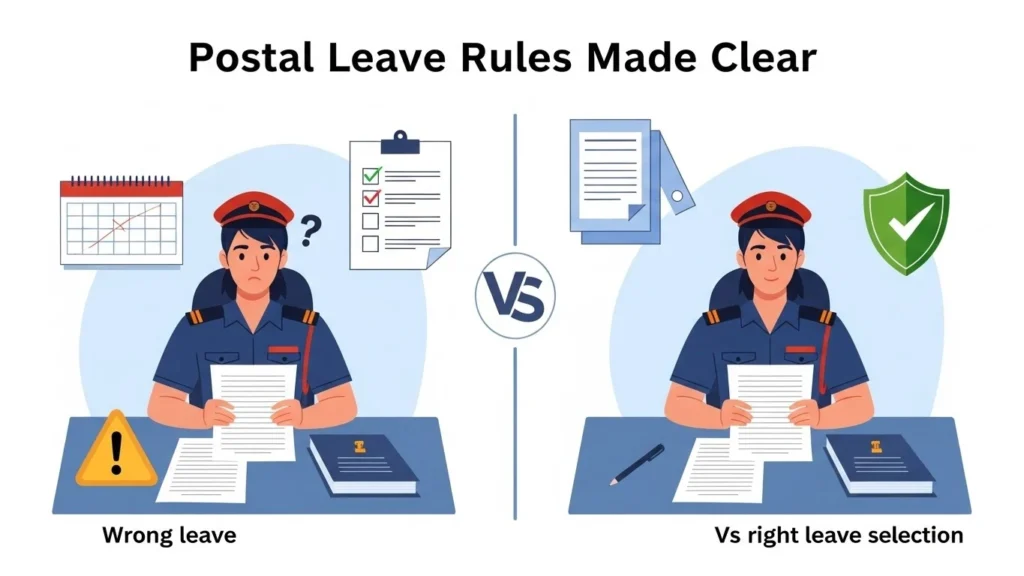
Postal Leave Rules Made Clear: Avoid Rejection, Salary Loss & Warnings
Leave Rules: Are you also confused about leave rules for postal employees? When I joined the Postal Department, I kept asking snior officials, but their explanations only made things more confusing. No one could clearly explain the exact leave rules.
A single wrong choice can lead to leave rejection, salary deduction, or official warnings. This practical guide breaks down postal leave rules in simple terms, explaining what to apply, when to apply, and what mistakes to avoid. From Casual Leave and Earned Leave to Medical, Commuted, CCL, and EOL, this article helps postal employees make the right leave decisions every time. Read before applying for leave and protect your pay, service record, and future benefits.
The golden rule is simple:
Right leave based on the situation is SAFE.
Wrong leave selection becomes a PROBLEM.
Let’s understand each leave type, its usage, and consequences.
Leave Application & Discipline Rules
Best Practices
- Apply leave in advance whenever possible
- Inform office immediately in emergencies
- Get approval before leave
Strict Rule
Unauthorized absence = No approval = Pay cut
Casual Leave (CL) – Short and Simple Leave
Eligibility & Availability
- 8 days per year
- Credited once every calendar year
- Cannot be carried forward
When to Use
- Short personal needs
- Fever, minor illness (1–2 days)
- Cannot be combined with HPL or EL
- Maximum 05 in one stance with approval of higher officials.
Examples
- 1 day CL for fever → Approved
- CL for school meeting → Approved
Don’ts
- Do not use CL for long durations
- Do not combine CL with EL or HPL
Consequences
- CL + EL/HPL applied → Leave rejected
Repeated misuse → Official warning (no increment impact initially)
Restricted Holiday (RH) – Optional Festival Leave
Availability
- 2 days per year
- From the notified holiday list only
Usage Rules
- Can be used only on notified days
- Can be combined with CL
- Lapses if not used in the year
Consequence Example
RH + EL applied → Leave rejected and changed to EL
Earned Leave (EL) – The Safest Leave
Availability
- 30 days per year
- Credited every half-year (January & July)
Accumulation Rules
- Maximum balance: 300 days
- Excess balance automatically lapses
When to Use
- Long personal or family leave
- Can be combined with HPL or Commuted Leave
Examples
- 12 days EL for village visit → Approved
- 20 days EL for surgery → approved with Full pay
Benefits
- Full salary during leave
- EL beyond 300 days converts to Leave Not Due (LND)
- EL encashment benefit at retirement
Medical Leave – Important Clarification
There is NO separate leave called “Medical Leave”.
Applicable Leaves for Medical Reasons
- Half Pay Leave (HPL)
- Commuted Leave
- Leave Not Due (LND)
Common Error
Applying “Medical Leave” directly → Converted to HPL
Half Pay Leave (HPL)
Usage
- Medical or personal reasons
- Half salary paid
- Can be combined with EL or Commuted Leave
Example
- HPL exhausted → LND approved
Commuted Leave (Medical – Full Pay)
Rules
- 1 day Commuted Leave = 2 days HPL
- Medical grounds only
- Full salary paid
Examples
- 10 days illness → 20 HPL debited, full pay given
- Used for medical reasons only
Important Note
- Commuted Leave is only a conversion of HPL
Not a separate leave type
Leave Not Due (LND)
When Applicable
- HPL exhausted
- Maximum 20 days at a time
Authority
- Approved by competent authority only
Warning
Repeated LND usage invites scrutiny
Maternity & Paternity Leave
Maternity Leave
- 180 days per childbirth
- Full pay
- Can be combined with EL or HPL
Example
- 130 days maternity leave → Full salary approved
Paternity Leave
- 15 days
- Must be used within 6 months of childbirth of before 15 days of confining
- Full pay
Example
- Applied within 2 months → Approved
- Applied after 7 months → Rejected
Child Care Leave (CCL)
Eligibility
- Total 730 days in entire service
Pay Structure
- First 365 days → Full pay
- Next 365 days → 80% pay
Usage
- Child care or examinations
Examples
- 20 days CCL for child illness → Approved
Extraordinary Leave (EOL)
When Used
- All other leaves exhausted
Pay
- No salary
Impact
- May affect increment and pension
Examples
- 20 days EOL → Salary stopped
Long EOL → Increment postponed
Leave Combination Rules (Crucial)
Allowed Combinations
- RH+EL- Rejected
- EL + CL- Rejected
- CL+EOL- Rejected
- CL+ RH- approved
- HPL + EL- approved
- CCL + EL/HPL (with approval)
Wrong Combination Results
- Leave rejection or modification
- Salary loss
Negative service record entry
Medical Certificate Rules
Requirements
- Certificate must be from an authorized hospital
- Must cover the exact leave period
Outcomes
- Valid certificate → Leave approved
Doubtful certificate → Disciplinary action
Conclusion
Leave rules are not just formalities—they directly affect your salary, service record, and future benefits.
The message is clear:
Right Leave = No Problem
Wrong Leave = Risk to Salary & Service Future
Every postal employee must understand leave rules clearly to avoid unnecessary trouble. Selecting the correct leave protects your salary, increments, and service record.
Stay informed, apply wisely, and always follow the correct leave procedure.
Also read this
Child Care Leave Rules: A Guide to Eligibility, Benefits, and Conditions
Maternity Leave Rules: A Simple Guide for Government Servants
Paternity Leave: A Comprehensive Guide for Government Servants

